

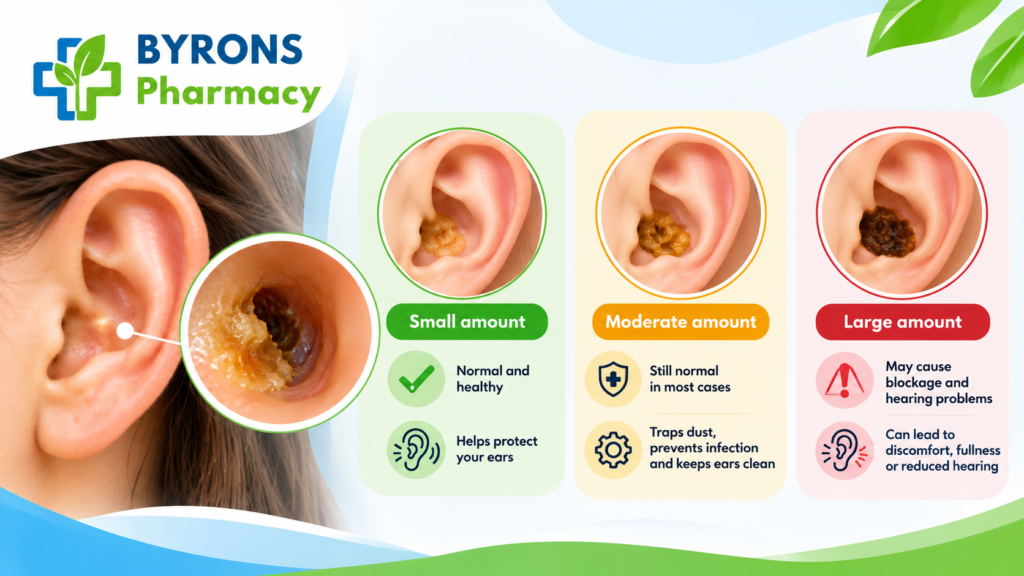
Quick Answer
A small amount of ear wax is completely normal and healthy, and the amount varies greatly between individuals. Healthy ears usually move excess wax out naturally. You generally do not need to remove ear wax unless it becomes impacted, affects hearing, causes discomfort or prevents a healthcare professional from examining the ear properly.
Introduction
Seeing ear wax can make people wonder whether their ears are dirty or whether they are producing too much. In reality, ear wax is a natural and useful part of ear health.
The medical term for ear wax is cerumen. It is produced inside the ear canal and helps trap dust, protect the delicate skin and reduce irritation from water and microorganisms.
The important question is therefore not simply, “How much ear wax is normal?” Instead, it is whether the amount of wax is causing any problems.
At Byron’s Pharmacy in Boxmoor, Hemel Hempstead, professional ear wax assessments and microsuction are available when troublesome wax has built up.
How Much Ear Wax Is Considered Normal?
There is no specific amount of ear wax that every healthy person should have.
The amount produced varies naturally from person to person. Some ears may have only a thin coating of wax, while others may produce noticeably more without experiencing any symptoms.
Ear wax is continuously produced in small amounts. Normally, natural movement of the skin inside the ear canal, together with jaw movement when talking and chewing, gradually carries wax towards the opening of the ear.
For most people, it eventually falls out without them even noticing.
NHS guidance confirms that wax is a normal protective secretion and does not usually need to be removed unless it is causing symptoms or interfering with examination or hearing-related care.
Ear Care Tip: Seeing some wax near the entrance of your ear does not automatically mean you have too much ear wax.
Why Do Our Ears Produce Wax?
Ear wax protects and lubricates the ear canal rather than simply being waste material.
Wax combines natural oils and secretions with tiny amounts of dead skin, hair and dust. This creates a protective coating along the ear canal.
Ear wax can help:
- Trap dust and small particles.
- Protect the delicate ear canal.
- Repel moisture.
- Reduce dryness and irritation.
- Support the ear’s natural cleaning process.
Ear wax is also slightly acidic, which helps provide some protection against bacteria and fungi. Having too little wax can sometimes leave the ear canal dry, itchy and irritated.
What Does Normal Ear Wax Look Like?
Normal ear wax can vary considerably in colour, texture and consistency.
Some people naturally have soft, sticky wax, while others have drier and more crumbly wax. Its colour may range from pale yellow or honey-coloured to brown or dark brown.
Dark wax does not automatically mean there is an infection or serious problem. Older wax often becomes darker as it remains in the ear canal and picks up dead skin and debris.
What matters more is whether you develop new symptoms such as pain, significant hearing loss, discharge or a persistently blocked sensation.
Normal Ear Wax vs Excessive Ear Wax
The difference between normal and problematic wax is mainly about symptoms and blockage, not a specific visible quantity.
Normal Ear Wax | Excessive or Impacted Ear Wax |
Small or moderate amount | Blocks part or all of the canal |
No hearing problems | Hearing may become muffled |
No significant discomfort | Fullness or discomfort may develop |
Naturally moves towards outer ear | Becomes trapped inside the canal |
Usually needs no treatment | May require softening or removal |
Protects the ear canal | May interfere with hearing aids or examination |
Having a larger amount of wax does not necessarily mean it needs removing if it is not causing problems.
How Do You Know If You Have Too Much Ear Wax?
Ear wax becomes a concern when it builds up enough to cause symptoms or block the ear canal.
Common symptoms include:
- Muffled or reduced hearing
- A blocked or full feeling
- Earache
- Itching
- Ringing or buzzing in the ear
- Dizziness or vertigo in some cases
Symptoms may affect one ear or both ears.
The NHS notes that earwax build-up commonly causes difficulty hearing, a blocked sensation, earache and tinnitus.
An ear examination is the most reliable way to determine whether wax is actually responsible.
Why Do Some People Produce More Ear Wax Than Others?
Producing more ear wax can simply be a normal individual difference.
Some people naturally produce significantly more wax than others. This does not necessarily indicate poor hygiene or an ear problem.
Wax is also more likely to build up when the normal self-cleaning process of the ear is interrupted.
Factors that may contribute include narrow ear canals, increased hair inside the canal and naturally hard or dry wax. Older adults may experience more problems because ear wax tends to become harder and drier with age.
People who regularly wear hearing aids, earplugs or in-ear headphones may also experience more build-up because these devices can interfere with the natural outward movement of wax.
Do Hearing Aids and Earbuds Cause More Ear Wax?
They do not necessarily make the ear produce more wax, but they can make wax more likely to become trapped.
Anything worn regularly inside the ear canal may interfere with the natural movement of wax towards the outside.
Hearing-aid users may therefore notice recurring blockages or find that wax affects the performance of their devices.
If you regularly use hearing aids and experience repeated ear blockage, periodic professional ear checks may be useful.
Should You Clean Ear Wax Out Regularly?
For most people, routine cleaning inside the ear canal is unnecessary.
Healthy ears are generally self-cleaning. You can gently clean the visible outer ear, but there is usually no need to insert anything deeper.
Cotton buds are one of the most common causes of avoidable wax problems because they can push wax further towards the eardrum rather than pulling it out.
Other items that should not be inserted into the ear include:
- Hairpins
- Ear picks
- Fingers
- Keys or similar objects
- Ear candles
- Home vacuum devices
NHS advice specifically warns against putting cotton buds, fingers or other objects into the ear canal because they may push wax further inside.
Remember: The goal is not to have completely wax-free ears. A healthy amount of wax is supposed to be there.
Can You Have Too Little Ear Wax?
Yes. Having very little ear wax is not necessarily harmful, but the ear canal can become dry and irritated if its natural protective coating is reduced.
Ear wax helps lubricate the skin inside the canal. Without enough of it, some people may experience dryness, itching or irritation.
This is another reason why repeatedly attempting to remove every visible trace of wax is unnecessary.
Ear cleaning should focus on keeping the outer ear clean rather than trying to make the ear canal completely free of wax.
When Should Ear Wax Be Removed?
Ear wax generally needs attention when it is causing symptoms, creating a blockage or interfering with medical care.
Removal may be considered when wax causes hearing difficulties, discomfort or persistent blockage.
It may also need to be removed if it prevents a healthcare professional from seeing the eardrum properly or interferes with hearing-aid fitting or testing.
The method used depends on the condition of the ear and the individual patient.
What Happens During Professional Ear Wax Removal?
Professional treatment begins with examining the ear to confirm whether wax is actually present.
At Byron’s Pharmacy, ear wax removal is offered as one of its specialist healthcare services in Boxmoor, Hemel Hempstead. The pharmacy’s booking service currently lists microsuction for both one-ear and two-ear appointments.
During a typical appointment, the healthcare professional can assess the ear canal and determine whether professional removal is appropriate.
Microsuction uses controlled suction to remove problematic wax while the ear is viewed directly.
Not everyone who thinks they have wax necessarily needs it removed. An examination may show that another issue is responsible for the blocked feeling.
What Are Common Misconceptions About Ear Wax?
“Any visible ear wax means my ears are dirty.”
No. Ear wax is normal and forms part of the ear’s natural protection.
“The more wax I have, the worse my ear health is.”
Not necessarily. Some people simply produce more wax than others.
“Healthy ears should contain no wax.”
Incorrect. A small amount of wax is healthy and protective.
“Cotton buds keep ears clean.”
Cotton buds may actually push wax deeper into the ear canal and contribute to impaction.
“Dark ear wax always means infection.”
No. Ear wax naturally varies in colour, and older wax can become darker.
When Is It More Than Just Ear Wax?
Not every blocked ear or change in hearing should automatically be blamed on wax.
Seek appropriate medical advice if you experience severe pain, discharge, bleeding, significant dizziness or other worrying symptoms.
Sudden hearing loss is particularly important. NHS guidance advises seeking an urgent GP appointment or NHS 111 help if you experience sudden hearing loss in one or both ears, hearing that rapidly worsens over several days or weeks, or hearing loss with symptoms such as earache or discharge.
Do not delay urgent assessment because you assume wax is responsible.
Why Choose Byron’s Pharmacy for an Ear Wax Check?
Byron’s Pharmacy provides professional ear wax removal services for people in Boxmoor, Hemel Hempstead and surrounding areas.
If your ears feel persistently blocked or your hearing seems muffled, an assessment can determine whether impacted ear wax is actually present.
Byron’s Pharmacy offers ear wax removal alongside its wider pharmacy and healthcare services.
Byron’s Pharmacy
49A St John’s Road
Boxmoor
Hemel Hempstead
HP1 1QQ
Rather than trying to remove wax yourself, professional examination can help identify whether treatment is necessary.
People Also Ask
How much ear wax should normally be in your ear?
There is no fixed amount. Ear wax production varies naturally between individuals, and wax usually only needs treatment when it causes symptoms or blockage.
Is having a lot of ear wax normal?
It can be. Some people naturally produce more wax than others without experiencing any problems.
Is it normal to see ear wax?
Yes. Wax near the outer part of the ear is usually completely normal.
Should you remove all ear wax?
No. Ear wax protects and lubricates the ear canal, so healthy wax does not need to be completely removed.
Why do I suddenly have more ear wax?
Changes may relate to natural wax production, age, hearing-aid use, earbuds, narrow ear canals or interruption of the ear’s normal self-cleaning process.
How do I know if my ear wax is impacted?
Blocked hearing, fullness, itching or tinnitus may indicate impacted wax, but an ear examination is the best way to confirm it.
Conclusion
So, how much ear wax is normal? There is no universal amount.
Some people naturally produce very little, while others produce considerably more. As long as the wax is not causing blocked hearing, discomfort or other symptoms, it will usually take care of itself.
Ear wax is protective, so trying to keep your ear canals completely wax-free is neither necessary nor helpful.
If you experience persistent blockage, muffled hearing or recurring wax problems, a professional ear assessment can determine whether removal is needed.
For ear wax assessment and microsuction in Hemel Hempstead, contact Byron’s Pharmacy in Boxmoor.
FAQs
Yes. Ear wax protects, lubricates and helps clean the ear canal.
Ear wax production naturally varies from person to person.
Not necessarily. Older ear wax often becomes darker.
Yes. Impacted wax can temporarily reduce or muffle hearing.
There is usually no need to clean inside the ear canal. Gently clean only the visible outer ear.
No. They may push wax deeper and make blockage worse.
Yes. Devices placed inside the ear may interfere with the natural movement of wax.
Byron’s Pharmacy in Boxmoor provides professional ear wax removal and microsuction services.